Milne Ice Shelf meteorite extraction
Deception PointThe Milne Ice Shelf meteorite extraction is the moment the expedition’s long hunt becomes a tangible spectacle: a huge, water-slick stone rises from the ice and hangs over the extraction shaft. For Rachel Sexton, its emergence transforms scientific claims into something she can see and the surrounding team can celebrate, making the extraction both a technical achievement and the emotional high point of NASA’s discovery.
The Moment of Surfacing
As the operation reached its climax, Norah Mangor climbed onto a folding chair and announced that surfacing was five minutes away. Scientists abandoned their tasks and converged on the extraction zone. When Rachel looked toward the thinning ice, the meteorite first appeared as a hazy, oblong shadow; technicians tightened the winches as the scaffolding creaked under the strain.
A switch extinguished a beam, and the stone broke through with a hiss of steam. The winch crew hauled until the meteorite came free of its frozen restraints, suspended on cables above an open shaft of simmering water. The scene’s suspense gives way to a sudden, physical reveal: the object that had existed beneath the ice as a target of instruments and expectation now hangs in front of the witnesses.
The Meteorite Made Visible
Dripping under fluorescent lights, the meteorite had a rugged, charred and rippled surface. One end was smooth and rounded, apparently blasted away by friction as it passed through the atmosphere; its dark fusion crust made visible the violent passage Rachel imagined it had taken toward Earth. The rock was at once a specimen and a material record of an ancient journey.
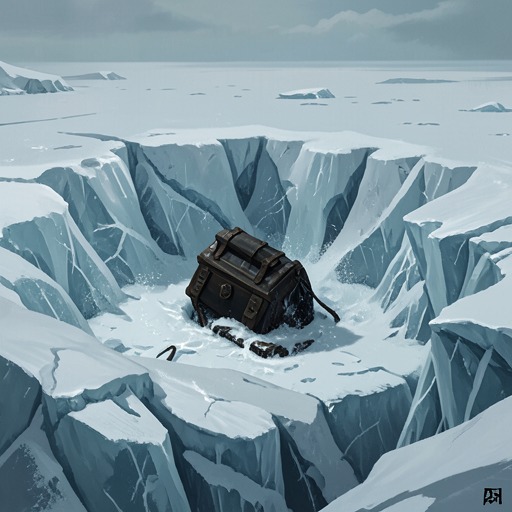
Its emergence also altered the landscape of the worksite. The meteorite had been raised from a shaft roughly two hundred feet deep, now filled with melted water. Once the stone was removed, the waterline settled about four feet below the glacier’s surface, a difference attributed to the meteorite’s removed mass and to ice shrinking as it melts. The exposed shaft remained dangerous: its solid-ice walls offered no footholds, so Norah immediately placed SHABA pylons around the opening to keep anyone from slipping in.
Revelation and Collective Response
The extraction makes the discovery’s claimed significance immediate for Rachel. The object before her is from another world, and the team understands it to contain evidence—indeed, proof—that humanity is not alone in the universe. The distinction between evidence and proof is momentous: in this scene, the meteorite’s physical presence appears to settle a question larger than the excavation itself.
The crowd’s response arrives as a shared release of tension. Hoots and applause break out; even Lawrence Ekstrom joins in, clapping team members on the back and congratulating them. Rachel feels joy for NASA, whose recent fortunes have been difficult, and believes the organization deserves this moment. The extraction thus shifts the scene from suspenseful labor to institutional vindication, although the confidence expressed here belongs to the characters’ understanding at this point in the story.
Achievement and Risk
Norah Mangor’s first response after the stone clears the ice is not celebration alone but site security: she rings the open shaft with warning pylons because a fall into its sheer, foothold-free walls would leave a person unable to climb out unaided. The operation has succeeded, yet success has created a new hazard in the form of the deep pool left beneath the work surface.
For Rachel, the dangling meteorite marks the end of the hunt. Its ascent closes the extraction effort and concentrates the expedition’s hopes in one visible object. The scene’s force comes from that convergence: cables, winches, steam, meltwater, and the gathered scientists turn an extraordinary claim into a shared physical encounter, while the shaft left behind keeps the danger of the ice present even in the moment of triumph.